
Ural is a Soviet-era guitar name associated with production in Sverdlovsk. The Ural 650 is especially relevant to vibrato collectors because of its distinctive bridge and arm-operated pitch-changing hardware. Frank Meyers’ illustrated Premier Guitar feature examines an original instrument and compares its design with Yamaha’s late-1960s SG family.
The Yamaha comparison is a description of design influence. It does not establish that the Ural mechanism is a Yamaha-made part, shares Yamaha dimensions or accepts Yamaha replacement hardware. “Ural 650 vibrato” identifies its application without assigning an unsupported factory part code.
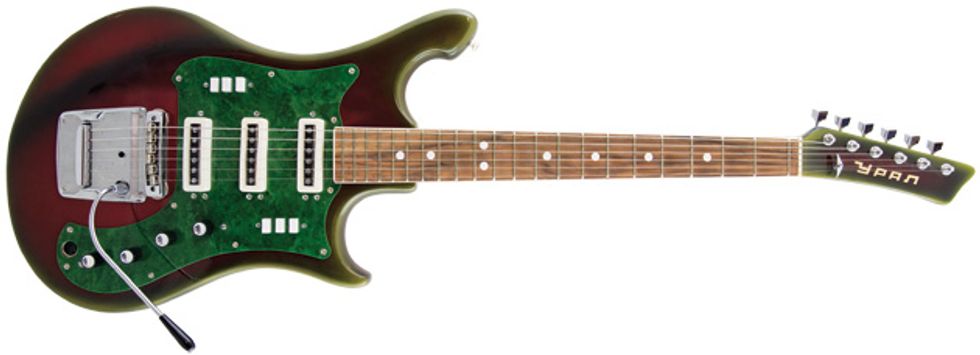
The 650 Hardware Family
Meyers describes the Ural 650’s bridge, headstock and vibrato as following the visual lead of Yamaha’s SG-5. His article illustrates a surviving Ural alongside a Yamaha SG-5A and places the Ural’s first illustrated production period in 1976–1980, followed by a later run with changes particularly apparent in the pickups.
Those production distinctions are useful for identifying the complete guitar. They do not, by themselves, prove that all early and late vibrato components are interchangeable. Record the mechanism actually fitted to the instrument rather than treating every 650 designation as a complete parts specification.
An Attributed Playing Account
Meyers reports that the arm and socket on the examined Ural felt satisfactory, but that tremolo use did not maintain tuning well. This is his published assessment of an original example. Condition, previous repairs and the rest of the string path need to be considered when evaluating another instrument decades later.
Restoration Priorities
Compare an original bridge, tailpiece, arm and spring arrangement as a complete system. Photograph screw positions and the cavity before dismantling, and check whether later repairs have changed the assembly. The Yamaha resemblance is useful for historical context but cannot replace measurements for a restoration.
The checked sources do not establish dependable arm-thread dimensions, mounting spacings, saddle materials or a modern drop-in substitute. Leave such measurements unassigned until they can be tied to a particular original unit or a verified factory drawing.