

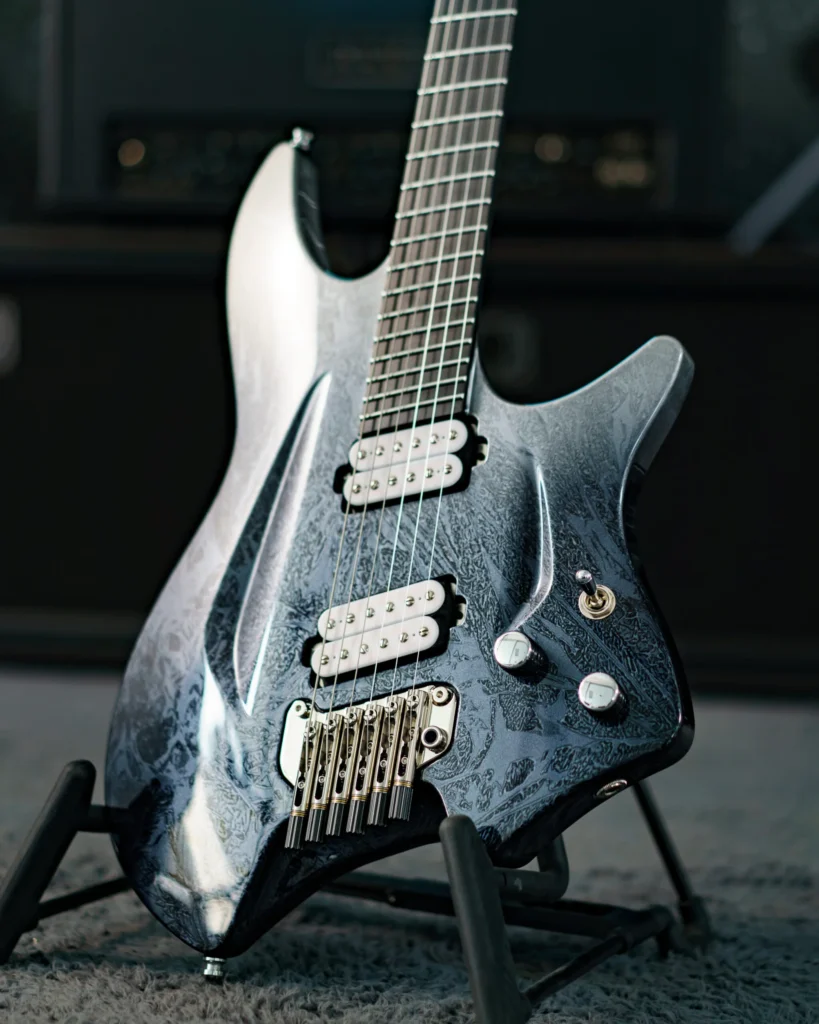
Aristides Instruments is a guitar maker whose bridge choices include a proprietary multiscale tremolo developed with Hantug. Its importance in a tremolo reference is the system’s geometry: it was designed around the differing scale lengths of a multiscale instrument, rather than simply placing a conventional rectangular tremolo behind a fanned-fret neck.
In its design history, Aristides says the system was introduced with its headless instruments in 2020 and subsequently developed for the headstocked S-Series in 2022. The same article identifies applications across the Headless, S-Series and STX-S ranges, subject to the scale-length layout.
Products and Bridge Options
The S-Series specification page lists the custom Hantug multiscale tremolo alongside a Hipshot-based multiscale hardtail and the Aristides Guitars EverTune option. These are different bridge choices: the tremolo provides player-controlled pitch movement, while the hardtail and EverTune-based arrangements serve different purposes.
Aristides documents six-, seven- and eight-string S-Series instruments. Hardware should be identified by the exact instrument configuration; the dimensions of one string-count or scale-length version do not establish the fit of another. The maker also lists black, chrome, gold and combinations of those finishes for the multiscale tremolo.
How the Multiscale Tremolo Works
The manufacturer describes a deliberately non-parallel relationship between the saddles and pivot line. In the illustrated design, the bass-side saddle sits 15 mm behind that line on the horizontal axis, while the treble-side saddle sits on it. The treble and bass pivot points also occupy different vertical positions within the bridge.
Aristides explains that this lets the treble strings remain approximately parallel to the body during a dive while the bass side moves differently. The stated design goal is closer pitch movement across the strings when using chords. This is the maker’s explanation of its mechanism, not a claim that every string changes by an exactly calibrated musical interval.
Installation and Compatibility
This is documented as a custom instrument-system option, not a universal aftermarket replacement for a standard two-post or Floyd Rose installation. A prospective build or repair needs confirmation of the guitar model, string count, scale lengths, saddle layout, pivot geometry and the exact replacement assembly.
Fingerboard-radius figures on an Aristides guitar specification describe the neck. They should not automatically be copied into a tremolo saddle-radius field. Likewise, a shared Hantug supplier does not make this custom multiscale system interchangeable with Hantug’s separate conventional locking tremolos.
Practical Notes
For an existing Aristides guitar, keep the instrument’s build specification with its hardware records and obtain setup or replacement advice for that configuration. The maker’s design article includes development images and a playing demonstration, making it a useful starting point for understanding movement and clearance. Artist endorsements elsewhere on the manufacturer’s site describe particular instruments and are not treated here as independent comparative hardware reviews.