
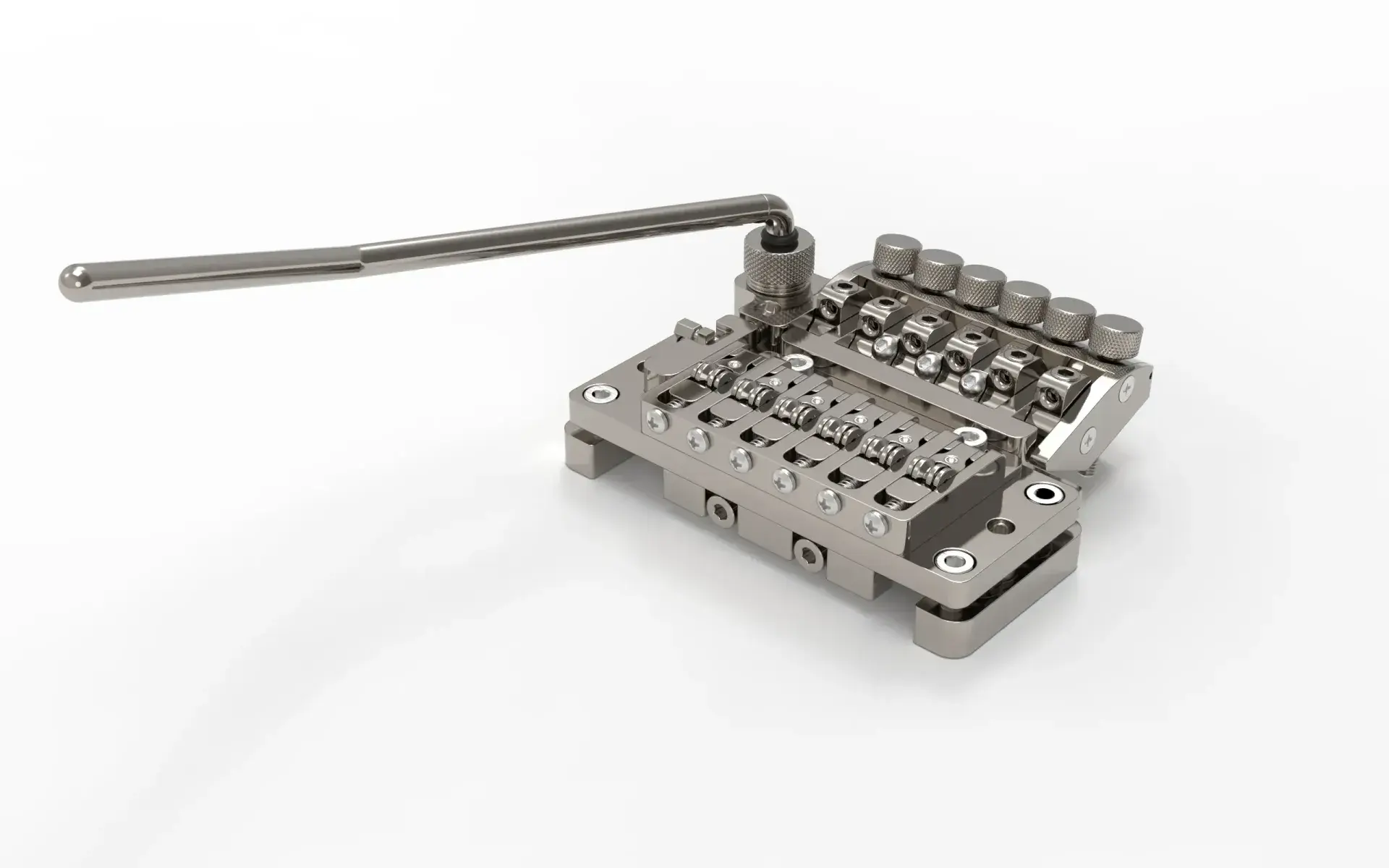
Shark Guitars develops the Shark Convertible Bridge, a bridge-and-tuning system with three selectable operating modes: tremolo, fixed bridge and maintenance. Its published construction uses linear movement and micro-roller bearings rather than the familiar layout of a pivoting Strat-style baseplate. See the six-string Shark Bridge.
The current catalogue includes six- and seven-string bridges, left-handed configurations and seven-string multiscale variants. These have their own parts and routing requirements. The six-string and straight seven-string product pages below provide concrete examples; their specifications should not be combined into one supposedly universal Shark installation. Compare the seven-string version.
Products and Tremolo Design
The six-string Convertible Bridge is described as machined from Grade 5 titanium. The maker lists 26 micro-roller bearings, 405 g total weight and full-range bridge tuners with more than 16 semitones of adjustment per string. The integrated tuners permit headless use without conventional headstock machine heads.
The seven-string page specifies Grade 5 titanium, identified as Ti-6Al-4V, plus a monoblock saddle assembly with individual string-height and intonation adjustment. It gives an 88.5 × 110.8 mm body-routing footprint for that model. These are the seven-string page’s figures, not dimensions inferred for the six-string or multiscale versions. Read the seven-string construction and installation details.
Features and Operation
The tremolo mode provides the moving pitch-control function; hardtail lock supplies fixed-bridge operation; maintenance mode is intended to support string and setup work. The maker says switching modes requires no tools. It also describes isolated string tension intended to keep the other strings at pitch when one is bent.
On the six-string page, three-axis adjustment is specified for independent control of string height, intonation and spacing. Full-range tuning at the bridge is a distinct function from these setup adjustments. The manufacturer’s terms such as “frictionless” and its claims for tuning independence describe the intended performance; they are not a substitute for an independent measurement.
Installation and Practical Notes
The documented installation uses routing from the front of the guitar. The seven-string page describes a two-pocket front route with no rear routing and says CNC templates in DXF/PDF format are supplied with OEM orders. Obtain the template for the exact string count, handedness and multiscale configuration before cutting a body.
A suitable neck-end nut or string-retention arrangement is also required for a headless build. Shark lists fixed and modular nut options separately, so confirm what is included with a particular bridge order. The checked pages do not establish a universal arm-thread specification or a single mounting pattern shared by all versions. Review the six-string system and companion parts.